Europe: Why Spanish gourmet products struggle to gain recognition
It remains a problem for Spanish gourmet products to be recognized at first glance in Europe. Undoubtedly, they are among the best you can find, but the competition often comes from mid-quality Spanish products being sold as gourmet… and they are not. Let’s see why.
We are the second country in the world and in Europe with the most international visitors, after France. We are also the country with the most Michelin stars, we have the number 1 restaurant in the World’s Top 50 and more than 10 chefs among the top 100. Even so, we are not perceived as “the crème de la crème” among gourmet products. Why? Well, basically because of our own fault. Yes, yes, we can’t blame others. It’s Spain that hasn’t done its homework properly.
Spanish gourmet products, despite their quality and tradition, face several challenges to be recognized and valued in European markets. Here are some key reasons:
-
Dominance of other European countries in the gourmet category
France and Italy have known how to position their premium products (cheeses, wines, cured meats) with a strong identity and aggressive marketing strategies. Often, consumers associate “gourmet” with these countries before they do with Spain. And this pending assignment for our country must be reversed once and for all. How? By more aggressively explaining our differences and strengths, such as Extra Virgin Olive Oil. We are the world’s largest producer, and Italy even has to buy our oil to be able to export “their oil”!! Are we stupid or what. If they don’t have more oil to export, because they produce 5 to 6 times what Spain produces, then they should stick to pasta and pizza.
Spain has the widest variety of extra virgin olive oils and does not need to sell our "liquid gold" to another country for them to take the credit and recognition. But that happens to us with jamón ibérico, sheep and goat cheeses, or gourmet preserves (Cantabrian anchovies, Mediterranean bluefin tuna, Galician mussels…), not to mention vinegars, sweets, nuts — in short, we should encourage national brands to explore other markets where consumers will surely enjoy our gourmet products once they discover them.
-
Lack of a unified country-brand strategy
Spain has exceptional products (jamón ibérico, olive oil, wines, cheeses), but they are not always presented under a unified identity that helps their international recognition. We don’t know how to come together in an intelligent, simple, and transparent way to go much further together and well aligned. The lack of unity is noticeable in the Made in Spain brand — it has not taken root as the Italians and French have with Made in Italy and Made in France. Associating a product with a country is much simpler for positioning it in the minds of people from other countries. Simplicity generates trust. In contrast, in Spain we are more disorganized (Products from Catalonia, products from Galicia, products from Castilla y León…), which creates confusion and laziness on the part of foreign consumers, because they shouldn’t be obliged to know all the regions of Spain.
If we worked on the brand Made in Spain Gourmet, many lesser-known products would benefit from its strength — for example, 100% Iberian-breed ham or EVOO, to name two examples.
-
Lower investment in marketing and branding
While France has developed the image of "savoir-faire" and excellence, and Italy that of "Made in Italy" with a strong emotional charge, Spain has not fully exploited the storytelling of its gourmet products. A strategy that, besides being real and simple, is straightforward: you only need to explain who we are, without lying, without exaggerating, sharing the good fortune we have in Spain of producing exceptional products with an unbeatable, inherent quality of raw materials. For that, again, we suffer from the same problem as with the country-brand strategy: we need more unity among product categories, to unify quality criteria so everyone conveys the same message more deeply and, of course, we must invest much more in digital communication, content and social media. That way no one can block us and we will reach the furthest corners of Europe.
-
Competition from lower-quality, cheaper products
In European markets, Spanish gourmet products compete with cheaper, lower-quality versions that entered earlier and were labeled as Spanish products = Spanish gourmet products — a big mistake that continues to harm higher-value Spanish products. This also makes it harder for European consumers to understand their true value. We must also fight against insiders who undermine higher-value, higher-quality products made in Spain. Here it is important to create quality seals, emphasize Protected Designations of Origin (PDOs), PGIs (Protected Geographical Indications), traceability seals, etc. If it is already hard to have to compete with other countries, having to do so against products from our own country — and of inferior quality — makes the effort we must undertake even greater. Sometimes, however, it is precisely our competitors who flood the market with lower-quality, cheaper Spanish products to emphasize the economic and quality value of their own and to reduce ours with lower-tier products (a divide-and-conquer strategy).
-
Logistical and distribution barriers
The lack of knowledge many Spanish gourmet brands have about international logistics means they have not advanced in optimization the way Italy and France have, which enjoy better geographic positioning toward the rest of Europe. In addition, we need to improve our relationships with European distributors by undertaking more public relations activities with them and product tasting events to build greater trust and brand value for Spanish Gourmet.
-
Consumer unfamiliarity or prejudice
In some markets, consumers are still not as familiar with Spanish gourmet products as they are with Italian or French ones. For example, prosciutto is better known than jamón ibérico, even though the latter is superior in quality, and despite the fact that the value of jamón ibérico as a category has been growing (this includes 50%, 75% and 100% ibéricos). The same applies to Spanish extra virgin olive oil, which also cannot compete with Italian oils on price (at the higher end) simply because the category’s foundation has not been developed as it should have been.
How to improve recognition of Spanish Gourmet products?
It's not an easy task, especially if there isn't a broad consensus among the brands that produce Spanish gourmet products.
Brand reinforcement. One of the first things we should do is create a strong gourmet identity for Spain, similar to that of France and Italy. With elements such as packaging, storytelling, values, traceability, and quality seals like D.O.s and I.G.P.s (PDOs and PGIs). But if there isn't a clear denomination like "Spanish Gourmet Product," it won't be easy. Brands' websites should be engines and showcases for them, where they can organically work without barriers on the correct positioning of products, categories, and the brand itself.
Greater consumer education. It's key, which is why there must be an obsession with creating educational content about the products, the brands, their history, their production… we need to explain the value of products and how they are made, so consumers understand how much it costs to produce them — for example, Iberian acorn-fed ham "pata negra" (36–48 months of curing) or extra virgin olive oil (early harvest, different olive varieties…), and their origin certifications…
Leveraging trends. Incorporate Spanish products into global culinary trends (e.g., tapas in haute cuisine, fusion with other cuisines).
Presence at international trade shows and events: More visibility in key markets to increase recognition and prestige (Asia, U.S., France, Italy).
Much remains to be done, but there are people and companies like Made in Spain Gourmet, and we know this is the only way forward: to develop the space we deserve and must defend, because our cuisine is a global reference, yet we are not positioned at the country and brand level to back that up. Let's keep going!
Our recommendations
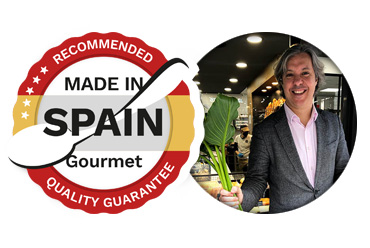 AUTHOR: Israel Romero, CEO of Made in Spain Gourmet.